
Musty Smell, No Visible Mold? What Homebuyers Should Know About Indoor Air Risk

Fresh paint and new finishes do not confirm clean air. A home can look cosmetically perfect and still have active mold growth behind drywall, under vinyl plank flooring, or inside attic and basement assemblies. That is the central indoor air quality blindspot for buyers: visually attractive spaces can hide persistent ambient moisture and elevated airborne particulate matter.
What you smell may be chemistry, not imagination. Odour complaints are often linked to microbial volatile organic compounds (mVOCs), which can be present before visible growth is obvious. The right response is not panic. It is measured, evidence-based due diligence that identifies whether moisture is active, historical, or fully remediated.
New Brunswick context: Leaky roof transitions, unvented bathrooms, and hydrostatic basement pressure are common moisture reservoirs in this region. Left unresolved, these pathways can elevate indoor spore concentrations over time even when finishes appear new.
Why IAQ Problems Often Stay Hidden During Showings
Showings are short, windows are often open, and odours are easy to dilute temporarily. That can make a property feel “fine” for 20 minutes while underlying moisture conditions remain active in concealed spaces. By the time staining, bubbling paint, or visible colonies appear, the moisture source may have been present for months.
This is also where the flipped-home blindspot appears. Some renovated homes receive new drywall, trim, or vapor-impermeable flooring directly over damp substrates without correcting drainage or ventilation failures. The result can be a sealed cavity that looks clean at viewing time but continues to incubate microbial activity after closing.
For buyers, the objective is simple: separate cosmetic presentation from measurable environmental performance.
How IAQ Testing Actually Works
A standard spore-trap test is a controlled air-sampling process, not a guess. A calibrated pump draws a fixed volume of air (commonly about 75 litres) through a cassette that contains a sticky collection surface. That slide is sent to an accredited lab, where it is examined microscopically to quantify and identify common mold genera such as Cladosporium, Aspergillus/Penicillium, and Stachybotrys.
Just as important, indoor samples have limited meaning without an outdoor control sample. The exterior sample establishes the local baseline for that day’s environmental conditions. Interpretation then compares indoor counts and genus patterns to the outdoor baseline to determine whether indoor amplification is likely.
In other words, a single indoor number without baseline context is weak evidence. Indoor-versus-outdoor comparison is where decision-grade value comes from.
What Drives Elevated Spore Counts in Real Homes
Most IAQ failures are moisture failures first. In Fredericton and Oromocto housing, the recurring drivers are usually building-science issues rather than “dirty house” conditions.
- Roof and envelope leakage: Water entry at flashing, roof penetrations, or siding transitions can sustain concealed moisture in sheathing and framing.
- Unvented or poorly vented bathrooms: Humid exhaust air discharged into attic spaces can create repeated condensation and biological growth.
- Hydrostatic basement pressure: Water pressure against foundation walls can keep basement materials persistently damp, especially through thaw/rain cycles.
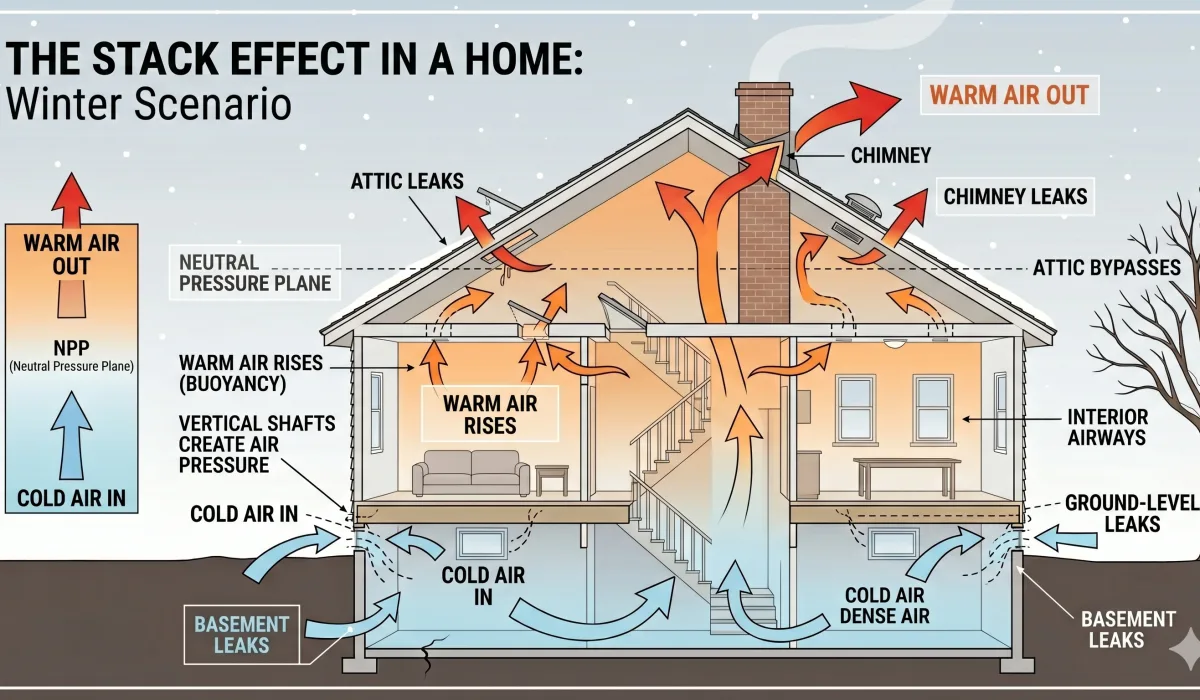
In multi-level homes, this can be amplified by the stack effect: warm air rising upward creates negative pressure below, pulling damp, potentially spore-heavy air from basements or crawlspaces into main living areas and bedrooms.
Red Flags to Watch For During a Showing
If you suspect air-quality risk, use a practical checklist instead of relying on impressions:
- Ghosting and Staining: Dark discoloration along exterior-wall stud lines or ceiling joints, often linked to condensation tracking and thermal bridging.
- Efflorescence: White, powdery mineral deposits on basement concrete, indicating active moisture migration and hydrostatic pressure history.
- Warping Trim: Baseboards cupping or pulling from drywall near floor lines or window zones, suggesting repeat moisture cycling.
- Exhaust Mechanicals: Bathroom or kitchen fans terminating into attic space instead of fully outdoors, which can drive sustained attic humidity.
These clues do not prove a major defect by themselves. They tell you where targeted testing and moisture verification should occur during conditions.
The Real Estate Condition Window Playbook
In fast transactions, IAQ timing matters as much as IAQ findings. Lab analysis typically takes about 2 to 3 business days. If mold or air-quality concerns are suspected, sampling should be performed at the same time as the standard visual home inspection, not after.
This sequencing gives you the best chance of receiving interpreted results before condition removal. Delaying sampling until late in the window can leave you negotiating without data or requesting an extension under pressure.
If you want this handled within one coordinated scope, our Indoor Air Quality Testing Service is designed to pair moisture-focused inspection findings with lab-based air sampling interpretation in the same due-diligence window.
How to Read Results Without Panic
Good IAQ interpretation is comparative and practical. The question is not simply “Is any mold present?” Mold is everywhere in outdoor environments. The key question is whether indoor results show abnormal elevation or unusual genus patterns relative to the outdoor control baseline and known building conditions.
When elevated findings are confirmed, the next step is source correction and controlled remediation scope, not cosmetic cover-up. Buyers who focus on cause-and-correction generally make better decisions than buyers who focus on odour alone.
Buyer Questions That Protect Your Decision
- Source clarity: What is the most likely moisture source, and what evidence supports that conclusion?
- Urgency split: Which items require correction before occupancy versus planned first-year maintenance?
- Data sufficiency: Were indoor samples interpreted against an outdoor control baseline from the same testing window?
- Scope impact: Would specialist remediation change the purchase decision or mainly refine scope and budget?
- Timeline fit: Can all testing and interpretation be completed before condition removal deadlines?
These questions keep the conversation analytical and grounded in remediable science, which is exactly what you need in a high-stakes purchase.
After Closing: Keep Air Quality Stable
If you proceed on a home with manageable IAQ concerns, stability comes from moisture control discipline: exterior drainage management, verified fan exhaust to exterior, humidity monitoring, and periodic re-checks in previously flagged zones. This system-based approach is usually cheaper and more durable than repeated cosmetic touch-ups.
The Bottom Line for Homebuyers
Musty odour concerns are not automatically a walk-away event, and they are not automatically harmless. They are a signal to gather better evidence before conditions clear. With a moisture-focused inspection scope, properly designed air sampling, and baseline-based lab interpretation, you can make a confident, measured decision instead of a reactive one.
If a property presents IAQ concerns, schedule an inspection that combines moisture pathway analysis with timely air-quality testing. In IAQ, the strongest protection is not fear. It is early, structured, and verifiable due diligence.